

The question usually arrives in one of two forms. Either someone is worried they have become de facto without meaning to, or a relationship has ended and they are wondering whether they have any claim.
Both deserve a clearer answer than the one in general circulation, because the common belief that you become de facto automatically at the two year mark is not quite how the law works.
There is no single moment you become de facto
Unlike marriage, there is no ceremony, no certificate and no date on which your status changes. A de facto relationship is a question of fact, assessed afterwards by looking at how the relationship actually operated.
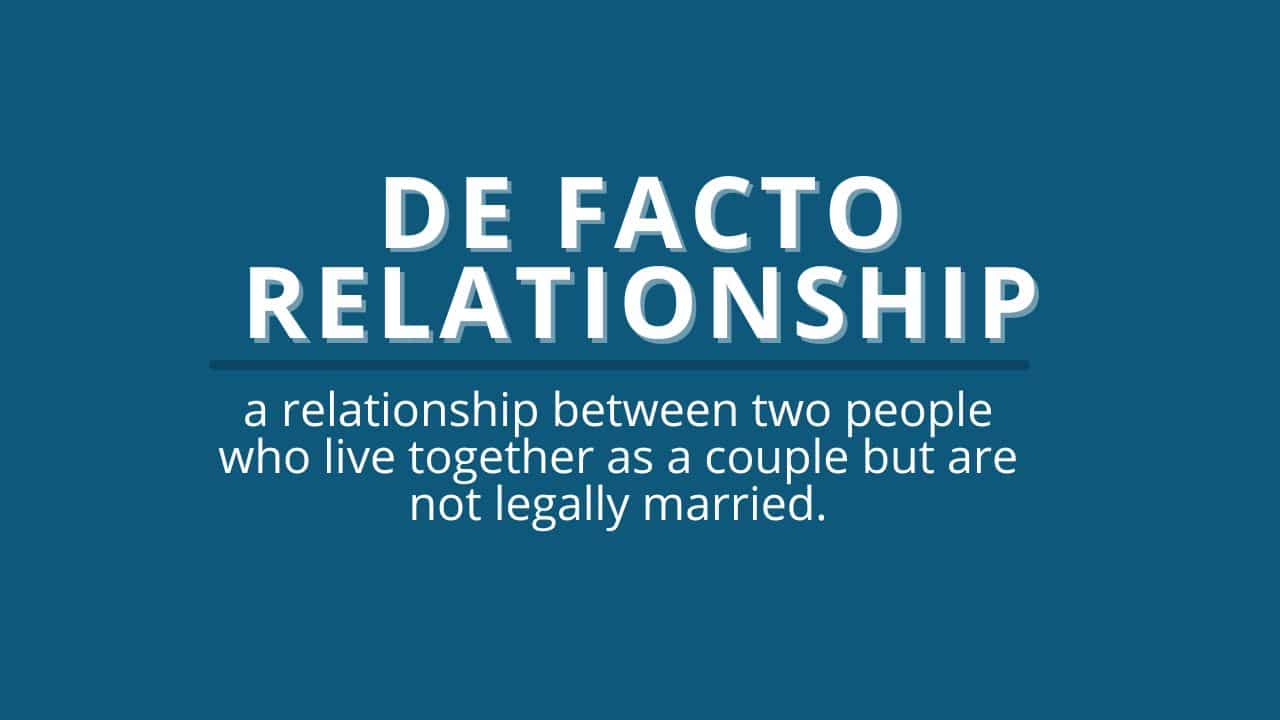
The starting definition is deliberately broad. The law requires that you and your former partner, who may be of the same or opposite sex, had a relationship as a couple living together on a genuine domestic basis, and that definition sits in section 4AA of the Family Law Act 1975.
Two points follow from that wording. You cannot be in a de facto relationship with someone you are legally married to, or with a person you are related to by family. And because it is a question of fact, two couples who look similar from the outside can land on different sides of the line.
What the law actually looks at
Rather than applying a test with a pass mark, the court weighs a range of circumstances. No single one decides it, and a relationship can qualify without ticking every box.
| Area considered | What it covers |
|---|---|
| Duration | How long the relationship lasted |
| Living arrangements | Whether and how you shared a residence |
| Financial interdependence | Shared accounts, bills, debts and support |
| Property | Ownership, use and acquisition of property |
| Commitment | Mutual commitment to a shared life |
| Children | Whether there are children and who cares for them |
| Public aspects | How the relationship was presented to others |
| Registration | Whether the relationship was registered under state law |
In practice, financial interdependence and the presence of children carry considerable weight, because both are difficult to characterise as anything other than a shared life. A couple who keep entirely separate finances, maintain separate homes and tell nobody they are together present a very different picture from one with a joint mortgage and a child.
The two year rule is a gateway, not a definition
Here is where the common understanding goes astray. The two year figure is real, but it is not what makes you de facto. It is one of several ways to satisfy the court that it has the power to deal with your property dispute at all.
Before the court can determine a de facto financial dispute, you must satisfy it that you were in a genuine de facto relationship which has broken down, that you have a geographical connection to a participating jurisdiction, and that you meet at least one of four alternatives.
- Duration. The relationship lasted at least two years.
- A child. There is a child of the de facto relationship.
- Registration. The relationship is or was registered under state or territory law.
- Contributions. One party made significant contributions and a failure to order would cause serious injustice.
The practical effect is that a relationship of eight months can come within the court’s power if there is a child, or if one partner made significant contributions to the other’s property and leaving it alone would be seriously unjust. Equally, a three year relationship is not automatically dealt with simply because it passed two years, since the court must still be satisfied it was genuinely de facto.
On the geographical point, a participating jurisdiction includes every Australian state and territory except Western Australia, which has its own arrangements for de facto property matters.
“Whether a relationship is de facto is assessed on its particular facts, not on a single date or a single document. Knowing which features the law examines helps you understand your position before decisions about property or finances need to be made.”
Centrelink is asking a different question
This causes more confusion than anything else, and it is worth being direct about. A great many people first encounter the phrase because of a payment, and they then assume the answer carries across to family law. It does not.
Centrelink works from the Social Security Act 1991 and asks whether you are a member of a couple, which is a separate statutory test with its own criteria. Services Australia considers the financial aspects of the relationship, the nature of the household, the social aspects of the relationship, whether there is a sexual relationship, and the nature of your commitment to each other, and notes that you can be a member of a couple even if all of those things are not part of your relationship.
Why the two can diverge
The tests overlap heavily, which is why the outcome is often the same, but they are not the same test and they are applied by different decision makers for different purposes. A determination that you are a member of a couple for payment purposes is not a finding that you are in a de facto relationship under the Family Law Act, and a decision that you were not de facto for family law purposes does not undo an assessment made about a payment.
There is also a reporting obligation that sits on the social security side rather than the family law side. If you receive a payment, you generally need to tell Services Australia within fourteen days when you start a relationship or your circumstances change.
Registering a relationship in Victoria
Victoria maintains a relationships register under the Relationships Act 2008, and registration is one of the four alternatives that brings a relationship within the court’s power regardless of how long it lasted.
You can apply to register a domestic relationship in Victoria if you are a couple, you are both at least eighteen, and at least one of you lives in Victoria at the time you apply. Both parties take part, both prove their identity, and each signs a declaration that they are not married and not in another registered or registrable relationship.
Registration suits couples who want certainty and recognition without marrying. It is worth understanding that it works in both directions, since it removes any argument about the threshold if the relationship later ends.
What being de facto actually exposes you to
The reason the question matters is that the consequences are closer to marriage than most people expect.
The general principles the court applies to dividing property are the same whether the parties were married or de facto, working from the assets and liabilities of each party, direct and indirect financial contributions, non financial contributions, contributions to the welfare of the family, the economic effect of any family violence, and each party’s future needs.
Superannuation can be split, and maintenance is also available. De facto partner maintenance can arise out of a de facto relationship in the same way spousal maintenance arises out of a marriage, and our page on spousal maintenance explains the threshold that has to be met.
If you would prefer to set the financial consequences in advance rather than leave them to be argued later, that is possible. Our pages on financial agreements and on de facto property settlements cover both routes.
When it ends, and why that date matters
The end of a de facto relationship is assessed the same way as the beginning, by looking at the facts, which means the date can be genuinely unclear where a couple separated gradually or stayed in the same home.
That date carries real weight, because the time limit for de facto property applications is two years from the breakdown of the relationship rather than the twelve months that applies after a divorce. Couples who separate but continue sharing a house should read our page on being separated under one roof, since the same evidentiary questions arise.
Once that window has closed you need the court’s permission to apply, and it is not always given. Our page on property settlements sets out the process while the window is open.
Key points
- A de facto relationship is a question of fact, not a status you elect.
- There is no date on which you automatically become de facto.
- The definition requires a couple living together on a genuine domestic basis.
- You cannot be de facto with a person you are married or related to.
- The court weighs duration, finances, property, commitment and public aspects.
- No single factor decides the question.
- The two year period is a gateway to the court’s power, not the definition.
- A child, registration or significant contributions can each open that gateway.
- A short relationship can qualify where there is a child.
- Western Australia is outside the participating jurisdictions.
- Centrelink applies a separate member of a couple test.
- A Centrelink finding does not determine your family law position.
- Payment recipients generally report relationship changes within fourteen days.
- Victoria allows couples to register a domestic relationship.
- De facto property applications run two years from separation.
The useful conclusion is that you cannot settle this question by counting months. If the financial side of your life is genuinely entangled with someone else’s, the law is likely to treat the relationship as significant well before any particular anniversary.
General information cannot assess your circumstances, and the consequences here are financial and lasting. If you are unsure where you stand, whether at the start of a relationship or after one has ended, it is worth getting advice specific to your situation.